
Kevin Jamey
Kevin Jamey

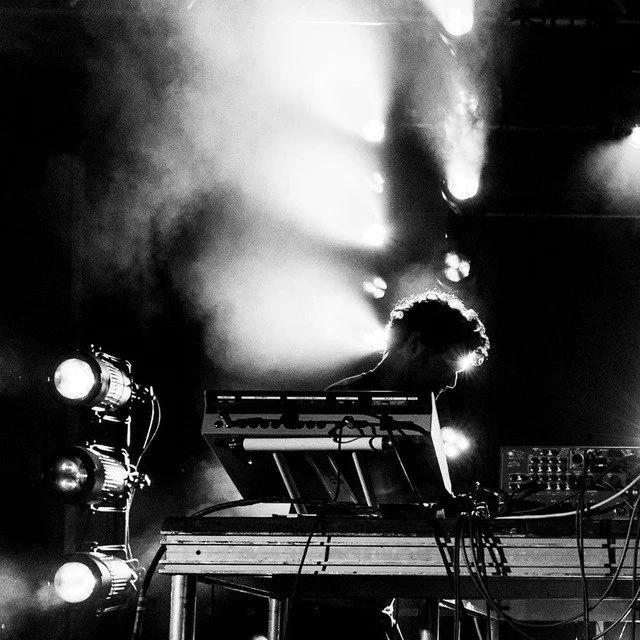
Kevin Jamey, PhD, Postdoctoral Fellow, Brain and Creativity Institute, University of Southern California, Electronic Musician as GROJ (Los Angeles, U.S.A.)
Kevin Jamey is a neuroscientist and electronic musician whose work explores how rhythm, musical harmony, and sound shape attention, emotion, and social connection. As a Postdoctoral Fellow at the Brain and Creativity Institute at the University of Southern California, he investigates how music influences attentional regulation across diverse populations. Trained in psychology and electroacoustic composition, Kevin works at the intersection of neuroscience and artistic practice, focusing on how structured sound can modulate perception and behavior. His research, supported by major international grants, contributes to understanding music as a tool for cognitive, social, and experiential design.
Under the moniker GROJ, he has performed internationally, including appearances at MUTEK (2011, 2017), engaging audiences across Europe, the Middle East, and South America. Performing across culturally distinct contexts has informed his perspective on sound as a nonverbal medium capable of shaping attention and emotional coherence.
His dual perspective, spanning laboratory and stage, grounds his interest in sound as a subtle layer of experience design. His work examines how minimal sonic experiences can create attentional continuity and support engagement across complex cultural environments such as museums.
The Invisible Bridge: Designing Attention to Build Trust Across Cultural Worlds
Every museum already has a soundtrack. The question is whether it is designed or accidental.
Footsteps, overlapping voices, audio bleed between installations, HVAC noise—these elements continuously shape how visitors perceive an exhibition. Left unmanaged, they fragment attention and can undermine the coherence of even the most carefully curated programs.
This talk proposes that bridging worlds in museums is not only a curatorial or narrative challenge, but an attentional one. When attention fragments, diversity reads as disjointed rather than connected, and trust erodes.
Drawing from neuroscience and music cognition, this talk introduces the concept of attentional sonic architecture: the design of sound-induced perceptual continuity across an experience. Human perception is highly sensitive to rhythm, repetition, and predictability. We trust systems that feel stable and internally coherent, from our own bodies to the environments we inhabit.
Sound has a unique capacity to shape this coherence. Unlike visual or textual elements, it can fill the perceptual field at a subliminal level, guiding attention without demanding it. Minimal, repetitive sonic structures, inspired by ambient and experimental music practices, can function as low-semantic infrastructure — present enough to stabilize perception, yet subtle enough to avoid competing with the artworks themselves.
In a field increasingly focused on intangible impact, attentional coherence may be a missing construct. It does not appear in standard metrics, but it manifests in how long people stay with a work, how smoothly they move through an exhibition, how consistently different audiences engage, and how similarly they describe what they experienced afterward.
To bridge worlds meaningfully, museums must design not only what is presented, but how it is perceived over time. Sound, when treated as attentional infrastructure rather than decoration, offers a precise and largely untapped way to do so.