
The invisible bridge: how sound connects minds, cultures, and worlds
From the brain to cultural strategy, sound reveals its power to build trust and bridge worlds in museum and arts experiences, echoing the vision of Communicating the Arts Ottawa-Gatineau 2026.
Why can a piece of music instantly transport us to a specific moment in our past, like Proust’s madeleine? And how can a gentle sound, or even a simple noise, so profoundly shape our experience of a place or a moment?
Sound and the brain: a neural bridge
At the heart of every note lies a neurological phenomenon. Sound does not simply pass through the ear; it engages complex patterns of neuronal activity.
When we are exposed to sound, music, or noise, brain regions responsible for emotion, memory, and action planning/monitoring light up simultaneously. Few human experiences engage such a wide array of neural networks at once.
In this sense, the Communicating the Arts Ottawa-Gatineau 2026 theme, “Building trust, bridging worlds,” resonates deeply with what happens inside us when we experience sound. The brain itself is a site of connection, an internal bridge mirroring the cultural bridges the arts seek to build externally.
Kevin Jamey at CTA 2026: connecting with audiences through designed sound
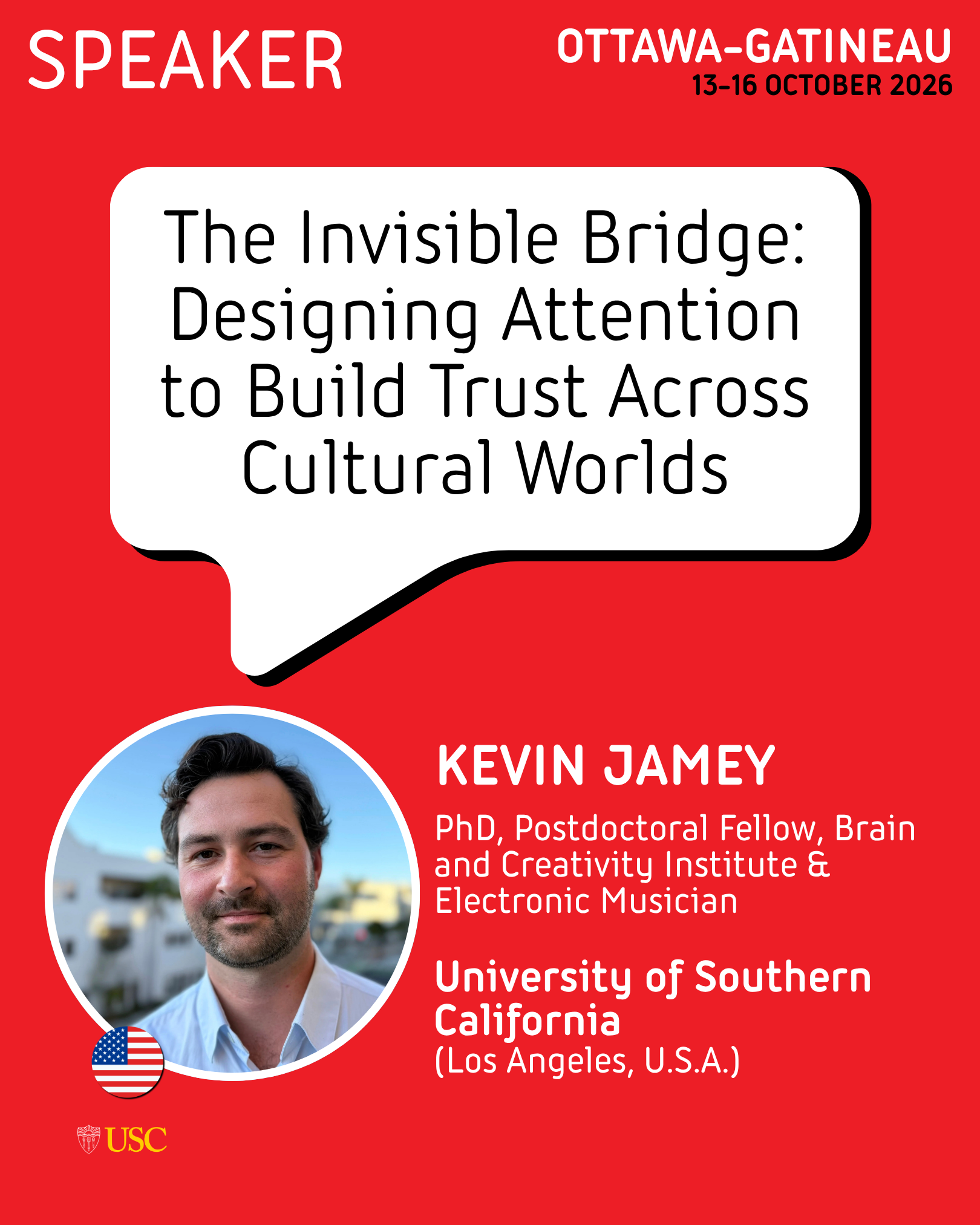
One of the core aims of Communicating the Arts is to draw parallels with fields beyond the cultural sector in order to deepen professional practice. This is precisely the focus of the keynote by Kevin Jamey, PhD, a cognitive neuroscientist affiliated with the Université de Montréal and the University of Southern California, whose research explores how music shapes cognition and neurodevelopment.
“Every museum already has a soundtrack, from footsteps to audio between installations and HVAC noise. The question is whether it is designed or accidental. We need to be aware that these sounds always shape how visitors perceive an exhibition. Left unmanaged, they fragment attention and can undermine the coherence of even the most carefully curated programmes,” he explains.
His talk, designing attention to build trust across cultural worlds, builds on his research into how structured sound can shape attention and perception across different contexts. Translating these insights into the museum space, he explores how minimal sonic structures using repetition, subtle variation, and simple sound can guide attention without competing with the artworks. The aim is not to add meaning, but to support continuity: creating a layer that visitors can ignore, yet that guides how the experience unfolds over time.
Bridging worlds through attention
We live in an era of constant distraction, and Kevin’s perspective suggests that bridging worlds in museums is not only a curatorial or narrative challenge, but also an attentional one. When attention fragments, diversity tends to be perceived as disjointed rather than connected, and trust begins to erode.
Drawing on neuroscience and music cognition, Kevin will also feature engaging live demonstrations as he introduces the concept of attentional sonic architecture: the design of sound-induced perceptual continuity across an experience.
From synapses to society
What begins as a neural process quickly expands into a social one. Sound synchronises not only brain activity, but also people.
In live performance settings, music often amplifies this effect most clearly: audiences breathe together, move together, and feel together to the beat of the music.
Often described as collective entrainment, this phenomenon shows how sound, and music in particular, can bring people into a shared emotional state. For cultural institutions navigating a fragmented world, this offers a compelling model. If trust is built through a structured shared experience, then sound, whether ambient or musical, becomes a strategic tool. It dissolves barriers of language, geography, and identity, allowing audiences to meet in a common sensory and symbolic space.
Memory, identity, and emotional resonance
The ability of sound to bridge worlds is perhaps most evident in its relationship with memory, shaping whether a place feels worth returning to. For cultural and arts leaders, this aspect cannot be underestimated. This insight can become central to cultural strategy, where the careful design of sound and the intentional use of music can profoundly shape the visitor experience.
A universal language for a divided world
In a time marked by division, sound and music remain among the few forms of communication that do not rely on shared language. They require no translation, yet they shape how we perceive and relate to an experience. They do not impose meaning, but they influence how meaning is formed. The vision behind Communicating the Arts Ottawa-Gatineau 2026 calls on the cultural sector to rethink its role: not just as a producer of content, but as a facilitator of connection, including through the design of sonic experiences.
Bridging worlds means creating continuity across difference. In that process, sound shapes the space of perception, while music introduces structure within it — together shaping how experiences are shared and remembered.
Written by Davide Mura - Editorialist, Communicating the Arts
