
Are you ready to become a media company?
Why editorial thinking is cultural institutions’ greatest competitive advantage in the age of AI
“Building Trust, Bridging Worlds.” Few conference themes capture today’s challenges as effectively as the one chosen for the 2026 Communicating the Arts Conference in Ottawa-Gatineau (13–16 October).
As AI reshapes how people discover culture, trust has become the defining asset of cultural institutions. Today, the greatest challenge is no longer attracting attention, but retaining control of the narrative as AI-generated summaries and recommendation systems increasingly shape first impressions. This raises a provocative question: what if museums and performing arts organisations started thinking like media companies?
Becoming year-round publishers
Cultural institutions have long built communications around exhibitions, productions and seasonal programmes. But audiences now expect the continuous engagement of Netflix, YouTube, Spotify and TikTok—what Deloitte’s 2026 Digital Media Trends describes as an “always-on” relationship with media. Exhibitions and performances are no longer the end point, but the beginning of an editorial journey. And the stories are already there: in archives, rehearsals, research, artistic processes and behind the scenes. The real question is no longer what to tell, but who should tell it—and how.
Building trust when AI becomes the intermediary
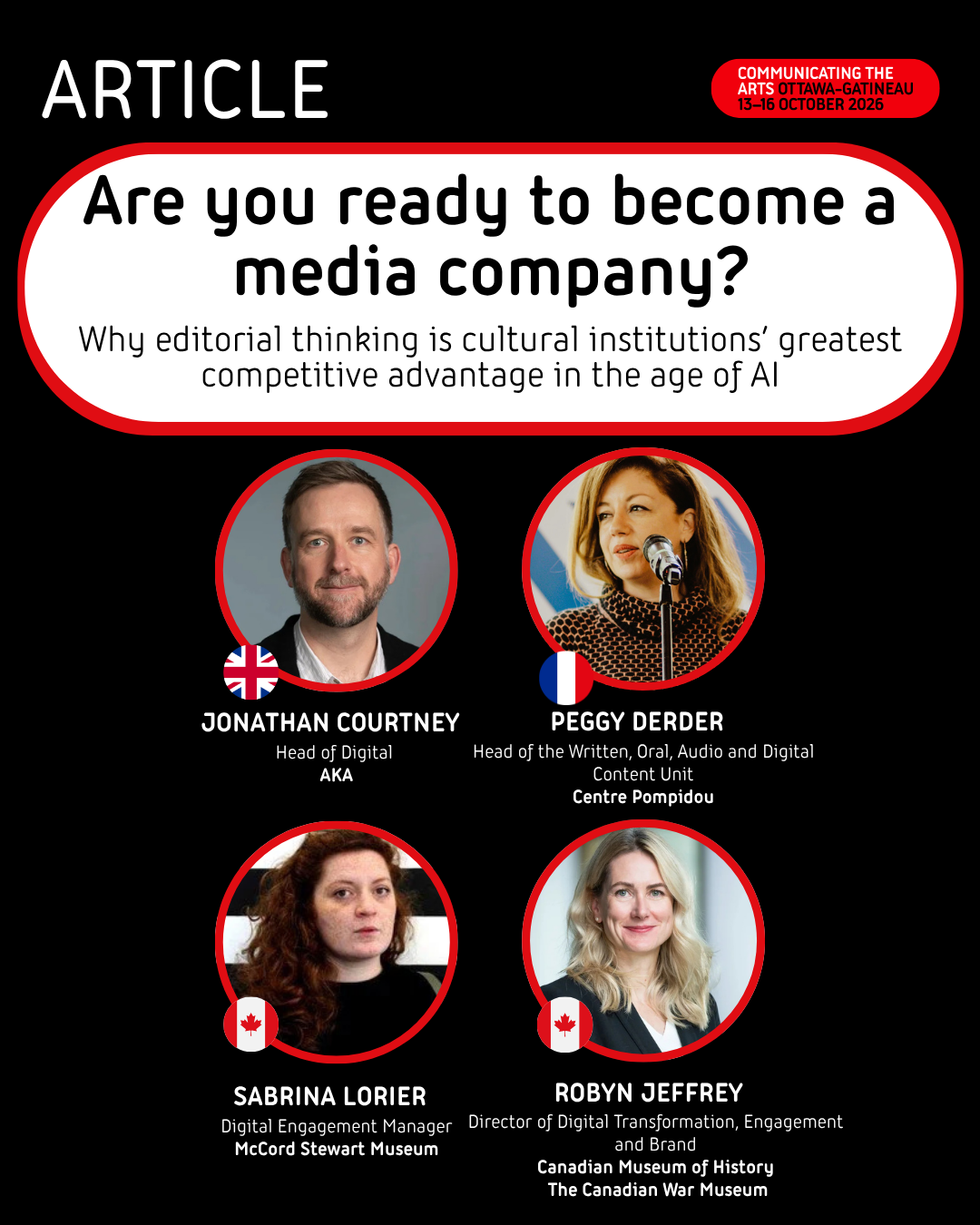
During the conference, Jonathan Courtney, Head of Digital at AKA, the London-headquartered global creative marketing agency specialising in theatre, live entertainment, and the wider arts and culture sector, will explore how generative AI is transforming audience behaviour in his presentation, Bridging the Gap: Audience Discovery, Trust, and First-Party Data in the Age of AI. Drawing on extensive research involving thousands of respondents across the UK and the United States, Courtney examines how audiences increasingly rely on AI to discover cultural experiences—and what that means for institutions seeking to maintain meaningful relationships with their visitors.
As discovery shifts to platforms institutions do not control, the priority is preserving direct audience relationships. Visibility is not enough: trust requires authentic connections beyond the algorithm.
When audiences become the storytellers
While Courtney explores the impact of AI on audience discovery, Peggy Derder, Head of the Written, Oral, Audio and Digital Content Unit, Centre Pompidou, offers a very different perspective: how participation can build trust.
Her presentation, The Centre Pompidou Sentimental Podcast: Building Trust Through Visitors' Voices, explores an extraordinary initiative launched as the museum prepares for its five-year closure for renovation.
Instead of producing its own institutional narrative, the Centre Pompidou invited visitors to contribute hundreds of voice recordings, creating an intimate portrait of the museum through memories, reflections and personal experiences.
The project transforms the institution from the sole author of its narrative into the editor of a collective conversation. Trust is built not only by presenting culture, but also by inviting audiences to help shape its story.
This participatory approach is well established in the media world, where publishers have shifted from one-way communication to audience participation, co-creation and community building. The same editorial logic is now emerging in cultural institutions, where visitors are becoming contributors rather than passive recipients.
Communication as dialogue, not broadcasting
Sabrina Lorier,Digital Engagement Manager at Montreal’s McCord Stewart Museum, explores this evolution in her session, Decolonizing Communication: How the McCord Stewart Museum Builds Dialogue with Its Community.
Through projects such as Little Burgundy – Evolving Montreal, she examines how institutional communication can move beyond promotion to embrace listening, collaboration and co-creation with diverse communities.
Her work asks how institutions can communicate histories shaped by exclusion without simplifying them, balance institutional authority with lived experience, and make communication itself an act of inclusion.
Communication becomes as much an ethical practice as a promotional one, helping institutions remain credible, relevant and genuinely connected to the communities they serve.
Digital transformation is ultimately about people
Technology alone is never enough. Robyn Jeffrey, Director of Digital Transformation, Engagement and Brand at the Canadian Museum of History and the Canadian War Museum, approaches the issue from an organisational perspective in Pillars, Partners, People: Driving Digital Transformations in Museums.
Her session focuses on the internal conditions required for successful digital transformation: clear strategic pillars, cross-functional collaboration, and strong partnerships both inside and outside the institution.
Her message is clear: digital transformation depends on strategic clarity, collaboration and partnerships. Technology matters, but people and organisational culture matter even more.
From cultural institutions to trusted media brands
Together, these sessions point to a profound shift. Cultural institutions are becoming trusted media brands—not by producing more content, but by consistently publishing knowledge, encouraging participation, and maintaining direct relationships with audiences.
Cultural institutions are following the media’s shift from periodic broadcasting to continuous publishing and long-term audience relationships. Their advantage, however, lies not in breaking news but in the authority, expertise and trust they already possess.
One key CTA Conference message is that trust also means cultural institutions remaining the primary authors of their own stories. Otherwise, increasingly, artificial intelligence will.
Editorial strategies
Smaller organisations may not need a chief editor, but they do need editorial leadership: someone who can coordinate storytelling, maintain a consistent voice and turn institutional expertise into continuous, audience-centred content.
This is the lesson media learned in the digital age: editorial leadership means orchestrating an ongoing conversation while preserving a trusted identity. For cultural institutions, thinking like media companies is ultimately about something bigger than communication: owning their stories before someone—or something—else tells them.
Written by Davide Mura - Editorialist, Communicating the Arts
