
Can rural cultural organisations rebuild communities?
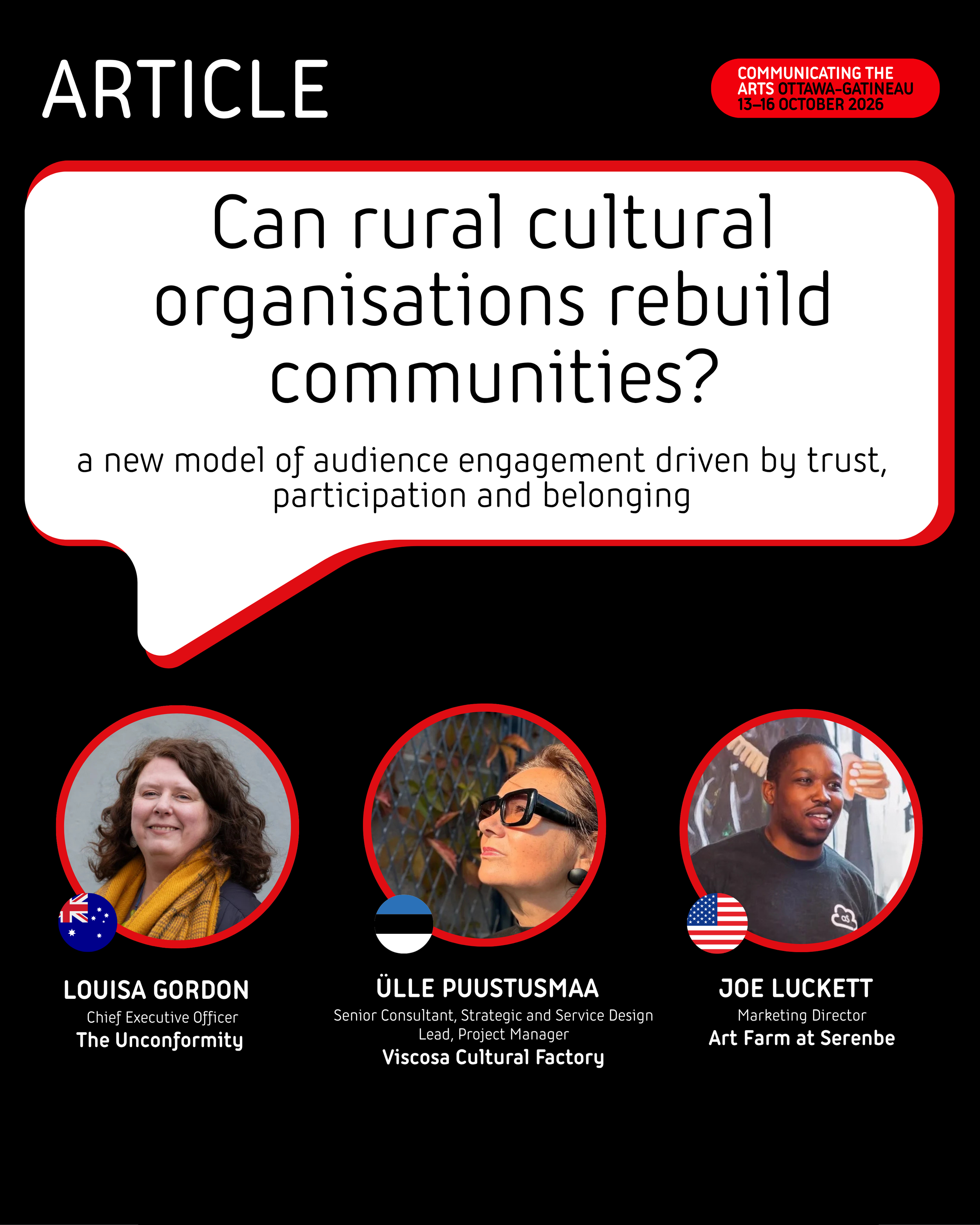
Three speakers at Communicating the Arts present a new model of audience engagement driven by trust, participation and belonging.
For years, the cultural sector has pursued a familiar ambition: greater visibility. More visitors, more followers, more clicks, more reach. Digital platforms have made it easier than ever to connect with audiences across the world, yet an uncomfortable paradox has emerged. While cultural organisations have become more visible, many people have become less connected—to their communities, to public life and, increasingly, to one another.
Perhaps the next frontier of audience engagement is not visibility at all.
At this year’s Communicating the Arts conference in Ottawa–Gatineau, Building Trust, Bridging Worlds (13-16 October), three organisations working far from major cultural capitals will offer a compelling alternative. Although their settings could hardly be more different, Art Farm at Serenbe (USA), Viscosa Cultural Factory (Estonia) and The Unconformity (Australia) all arrive at the same conclusion: culture creates its greatest impact when it becomes a catalyst for relationships rather than simply a program of events.
Their presentations suggest that rural arts organisations may be developing some of the most innovative approaches to audience engagement today.
Trust before attention
For Ülle Puustusmaa, Strategic and Service Design Lead, Project Manager at Viscosa Cultural Factory, communication begins with trust.
Located on the Estonian island of Hiiumaa, home to fewer than 10,000 residents, Viscosa has transformed a former industrial complex into a cultural hub where art serves a broader social purpose. In her session, Culture in Motion: How Viscosa Cultural Factory Fosters Connection and Trust on an Estonian Island, Puustusmaa explores how cultural institutions can become spaces where communities create shared meaning rather than simply consume artistic experiences.
Working in a remote location with limited cultural infrastructure and highly seasonal tourism, Viscosa has learned to balance local identity with international exchange. Its communication strategy reflects this complexity, addressing schoolchildren, artists, tourists, public institutions and local residents without losing its sense of purpose.
Rather than seeing remoteness as a limitation, the organisation has turned it into an asset. Its experience demonstrates that trust is not an outcome of successful communication—it is its foundation.
Why communication is participation
If Viscosa shows how institutions can build trust, Australian Louisa Gordon, Chief Executive Officer of The Unconformity, demonstrates how communication itself can become a form of participation.
Based in Queenstown on Tasmania’s remote west coast, The Unconformity has spent more than a decade creating contemporary arts experiences deeply rooted in local landscapes, history and community. But as the organisation evolved, its communications also had to change.
In her presentation, Gordon explains how The Unconformity moved away from highly controlled, occasional messaging towards a model based on continuous dialogue.
Monthly Open Halls invited residents into ongoing conversations. Collaborations with local musicians and students opened new pathways for participation. A more active digital presence maintained relationships between festivals instead of simply promoting events.
The lesson is particularly relevant for organisations navigating leadership transitions or institutional change. Communication is no longer simply about telling audiences what is happening. It becomes part of how organisations build transparency, trust and shared ownership.
In regional communities especially, Gordon argues, showing up consistently matters as much as speaking well.
Nature as a communication strategy
While digital engagement dominates today’s marketing conversation, American Joe Luckett, Marketing Director at Art Farm at Serenbe in rural Georgia, offers a different perspective.
His presentation, Rooted and Resonant: Building Trust Through Nature-Based Art and Digital Storytelling, explores how digital tools can strengthen—not replace—human connection.
Art Farm combines immersive performances, artist residencies, seasonal festivals and year-round storytelling to reconnect audiences with nature and with one another. Technology plays an important role, but not as the destination. Instead, digital channels become invitations to experience place, creativity and community more deeply.
Luckett also addresses the practical realities of marketing a rural arts venue: limited transport, inconsistent connectivity and geographically dispersed audiences. His response is not bigger advertising budgets but intentional partnerships, authentic storytelling and long-term relationship building.
His message is simple: rural does not mean remote. With the right narrative, even small organisations can create international resonance while remaining firmly rooted in local identity.
From audiences to communities
Taken together, these three presentations reveal a broader shift taking place across the cultural sector.
For decades, success has largely been measured through attendance and visibility. Yet organisations working in rural environments often have little choice but to think differently. Their communities are smaller, relationships more personal and cultural institutions more deeply woven into everyday life.
Artists, volunteers, residents and visitors frequently overlap. Participation replaces transaction. Belonging becomes more important than reach.
Ironically, the characteristics often seen as disadvantages—distance from major cities, smaller populations and limited resources—may now represent significant strengths. As societies confront loneliness, declining civic participation and fragmented communities, cultural organisations are increasingly expected to do more than present programmes. They are asked to create places where people reconnect.
A lesson for the whole sector
The experiences of Viscosa Cultural Factory, The Unconformity and Art Farm at Serenbe suggest that the future of audience engagement may not be defined by technology alone, nor by ever-increasing visibility.
Instead, it may depend on something both older and more difficult to measure: trust.
As delegates gather in Ottawa–Gatineau, these three speakers will invite the sector to reconsider one of its most fundamental assumptions. Perhaps the most successful cultural organisations of the future will not be those that simply attract the largest audiences, but those that build the strongest communities.
This is especially relevant at a time when many visitors are seeking experiences away from major city centres. For audiences increasingly drawn to slower, more meaningful and place-based cultural encounters, rural arts organisations may offer exactly what large urban institutions often struggle to provide: intimacy, authenticity and a renewed sense of connection.
Join us at Communicating the Arts 2026 in Ottawa-Gatineau and discover how co-creation with young people is reshaping the cultural sector.
Written by Davide Mura - Editorialist, Communicating the Arts
