
Can branding build trust in cultural organisations?
At Communicating the Arts Ottawa-Gatineau 2026, leading cultural institutions reveal how branding has become a strategic tool for trust, relevance, and public engagement through an approach centred on perception, trust, and emotional connection.
In the cultural sector, branding is no longer about logos, campaigns, or visual identity alone. It has increasingly become a form of leadership — the ability to shape how institutions are understood, trusted, and emotionally experienced by the public.
This shift will be at the centre of several major conversations during Communicating the Arts Ottawa-Gatineau 2026 – “Building Trust, Bridging Worlds” (13–16 October), where leaders from museums, performing arts organisations, arts institutions, and communications professionals will explore how they can redefine their role in an age of fragmented attention, digital saturation, and declining institutional trust.
One of the most compelling themes emerging from this year’s programme is the idea that branding is fundamentally about governing perception — not through manipulation, but through coherence. Perception leadership means aligning intention, behaviour, language, evidence, and ritual into a recognisable and credible institutional identity. In other words, making institutional narratives not only more readable, but genuinely relatable.
The brand becomes a system of shared interpretation: what people understand about us, what they feel, the narrative they associate with our presence, and ultimately the behaviours that such perception makes possible.
Strategic leadership therefore consists of governing these dimensions coherently, transforming reputation, identity, and narrative into concrete drivers of relationships, trust, and choice.
From awareness to emotional connection
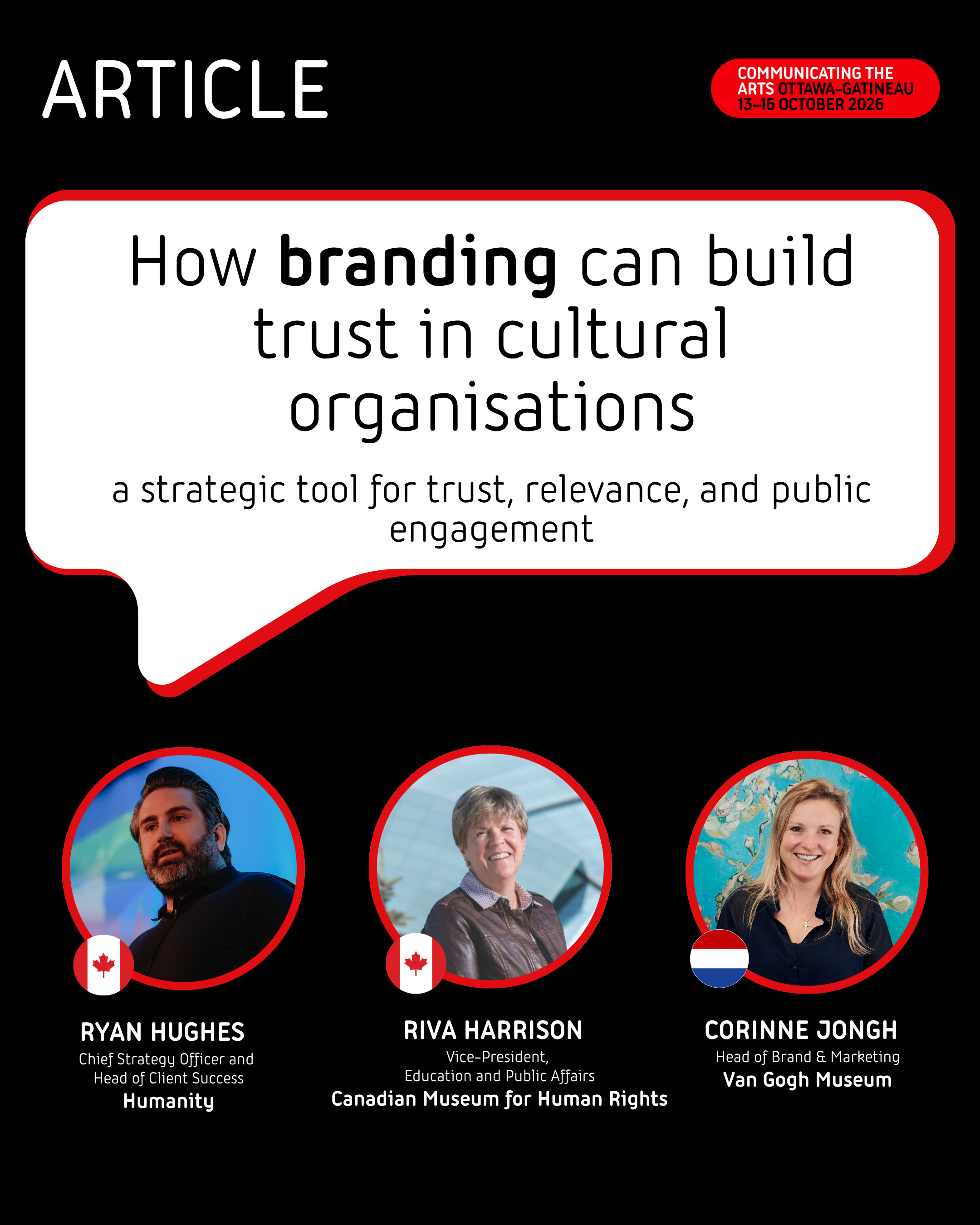
Among the presentations is the session from the Canadian Museum for Human Rights, led by Riva Harrison, Vice-President of Education and Public Affairs, alongside Ryan Hughes, Chief Strategy Officer at the Toronto-based purpose-driven agency Humanity.
Their presentation, Reimagining a museum: the challenge of branding human rights, addresses a fascinating paradox: how do you brand an institution dedicated not to artworks, but to an idea as vast and emotionally charged as human rights?
Rather than relying on traditional institutional messaging, the museum undertook a national behavioural research program combining psychoanalytic research, large-scale surveys, and semiotic analysis. The findings reshaped the institution’s communication strategy around a powerful psychological insight: audiences move from sympathy to empathy to empowerment before they are ready to engage or act.
This transformed the museum’s positioning. Human rights were no longer framed primarily as abstract principles or legal concepts, but as shared human actions and experiences. The result was a brand platform rooted in emotional participation and collective responsibility.
The human story behind the brand
Another keynote comes from the Van Gogh Museum, presented by Corinne Jongh, Head of Brand & Marketing.
In Building trust through a human-centred brand: how the Van Gogh Museum connects local and global audiences, Jongh explores how one of the world’s most visited museums has redefined its brand positioning by placing Vincent van Gogh’s humanity — not only his artistic genius — at the centre of its communication strategy.
The museum’s research identified a crucial challenge facing many globally recognised institutions today: transforming awareness into preference, particularly among younger and more diverse audiences.
The answer was not greater visibility, but greater relevance. By focusing on Van Gogh’s struggles, ambitions, relationships, and emotional life, the museum created a communication framework based on recognition and personal connection. This human-centred approach now informs exhibitions, public programmes, digital storytelling, and platform-specific social media strategies.
Communicating complexity internationally
Another important contribution comes from Amanda Kelly, Associate Director at Pickles PR in Valencia, whose presentation Narrating complexity: international communications strategies for museums explores how strategic communications can support nuanced public understanding in politically and socially sensitive contexts.
Drawing on collaborations with institutions including the National Gallery Singapore and the National Museum of Contemporary Art Athens (EMΣT), Kelly examines how museums working with themes such as displacement, feminism, migration, and postcolonial histories navigate increasingly polarised media environments.
Her presentation highlights how international communications strategies — from long-form editorial pitching and journalist visits to strategic partnerships and dialogue-building — can help institutions preserve curatorial nuance while strengthening global credibility and public trust.
The conference will also touch on the importance of cross-disciplinary thinking in cultural communication — an increasingly relevant dimension of contemporary branding. In his keynote Bridging Worlds, Arnel Rodriguez, Digital Lead at Communicating the Arts, explores how innovation often emerges from the intersection of disciplines, encouraging institutions to look beyond traditional sector boundaries to develop new forms of storytelling and audience engagement.
Branding as institutional strategy
Together, these presentations point toward a broader transformation happening across the cultural sector: branding is increasingly becoming an institutional operating system rather than a marketing layer.
The most effective cultural brands today do not simply communicate what organisations do. They shape how audiences understand them, emotionally experience them, and ultimately remember them.
At a time when public attention is increasingly fragmented and cultural authority continuously questioned, organisations are being forced to rethink not only how they communicate, but how they are perceived.
The emerging lesson from Communicating the Arts Ottawa-Gatineau 2026 is that branding is no longer peripheral to cultural work. It is becoming a way of shaping meaning, trust, and emotional relevance in society.
Written by Davide Mura - Editorialist, Communicating the Arts
